
Direct mail and email marketing: when to add a postcard to your retention flows
Guest article. In-box is a TouchDrop partner. TouchDrop added the card price and the screenshot.
Add a postcard when email and SMS have stopped working for customers who are still worth winning back. That includes lapsed repeat buyers, high-value customers who've gone quiet, and subscribers you're about to stop emailing. Send a postcard after email and SMS, and only to customers whose expected value covers the cost.
I run In-box, a Klaviyo email marketing agency that has built email and SMS programs for over 500 ecommerce brands. Here's how we decide if a postcard fits in a retention program, and how to tell if it's worth it.
When does a postcard add value?
Here are the three situations where postcards can add value:
- The customer stops opening. After a customer ignores emails for months, another email is unlikely to change that.
- The customer never opted into SMS. SMS consent can be hard to get. However, you have a delivery address if a customer has purchased before.
- The message needs more weight. Thank-yous to top customers, or "we'd love you back" offers sent by mail feel more personal than texts.
TouchDrop's own comparison of direct mail and SMS says the same.
Which customers should get one?
Previous customers drive most of the revenue in our accounts, so it makes sense to send postcards to them.
The best candidates are:
- Lapsed repeat customers. Including people who have placed two or more orders without one in the last 90 days. Although they've stopped engaging with emails, they already know and trust the brand.
- High-value customers going quiet. Your top spenders, before they lapse.
- Past buyers you're about to sunset. A card is a cheap final attempt at engagement.
- High-value abandoned checkouts. We'll cover a quick caveat on timing below.
Build these rules as Klaviyo segments, so they're consistent. Leave out subscribers who have never bought, anyone who has ordered recently, and customers whose order value doesn't cover the cost of the card.
How do you time a postcard around existing email and SMS flows?
Try the cheap channels first; postcards are a last resort. Timing also matters more with physical mail. Automated email campaigns check your segments daily and can send accordingly, but cards are not as instant.
According to TouchDrop's print and delivery guide, automated cards get printed and lodged only weekly. So, given typical delivery times of 3 to 7 business days, plan for cards to arrive about two weeks after someone qualifies. As most abandoned checkout recoveries happen within days, limit mail to high-value carts only after your email and SMS sequence.
A couple of TouchDrop safeguards limit postage costs. If a contact leaves the segment before the card prints because they ordered, for example, the card is cancelled. TouchDrop also applies a global suppression window after each send and caps the pieces of mail a customer can receive.
A postcard sequence, step by step
| Customer state | Email/SMS action | Postcard decision (Klaviyo trigger and filters) | When to recheck or stop | How it's measured |
|---|---|---|---|---|
| Lapsed repeat customer | Win-back emails from around 45 days after the last order, recommending products related to past purchases. SMS to opted-in customers. | Yes. Segment: placed order at least 2 times, zero orders in the last 90 days, no email opens or clicks in the last 60 days, has a valid address. | Card cancels if they order before print. Recheck after the attribution window. Respect the suppression window before mailing again. | Unique code and QR per card, customer and address matching, compared with a random holdout. |
| Lapsed one-time buyer | Win-back email with a second-order incentive. | Only if average order value and margin cover the card. Segment: placed order exactly once, zero orders in the last 90 days, has a valid address. | Stop after one card. If they don't respond, move them to the sunset flow. | Holdout comparison on second-order rate. |
| High-value customer (VIP) | Plain-text thank-you email from the founder after the order. | Yes, as a thank-you, not a promotion. Segment: lifetime spend or order count above your VIP threshold, ordered recently. | Once per milestone, such as a third order. | Repeat purchase rate against a VIP holdout. |
| Unengaged past buyer | Sunset emails: two attempts about 48 hours apart, then stop emailing. | One card before suppression. Segment: has ordered at least once, no email engagement in 120+ days, has a valid address. | No further mail if there's no response within the attribution window. | Reactivation rate against a holdout. |
| High-value abandoned checkout | Checkout reminder email and SMS sequence. | Only above a cart-value threshold. Segment: started checkout in the last 7 days, checkout value above your threshold, no order since. | Card cancels automatically if they order before print. | Unique code redemptions and order matching. |
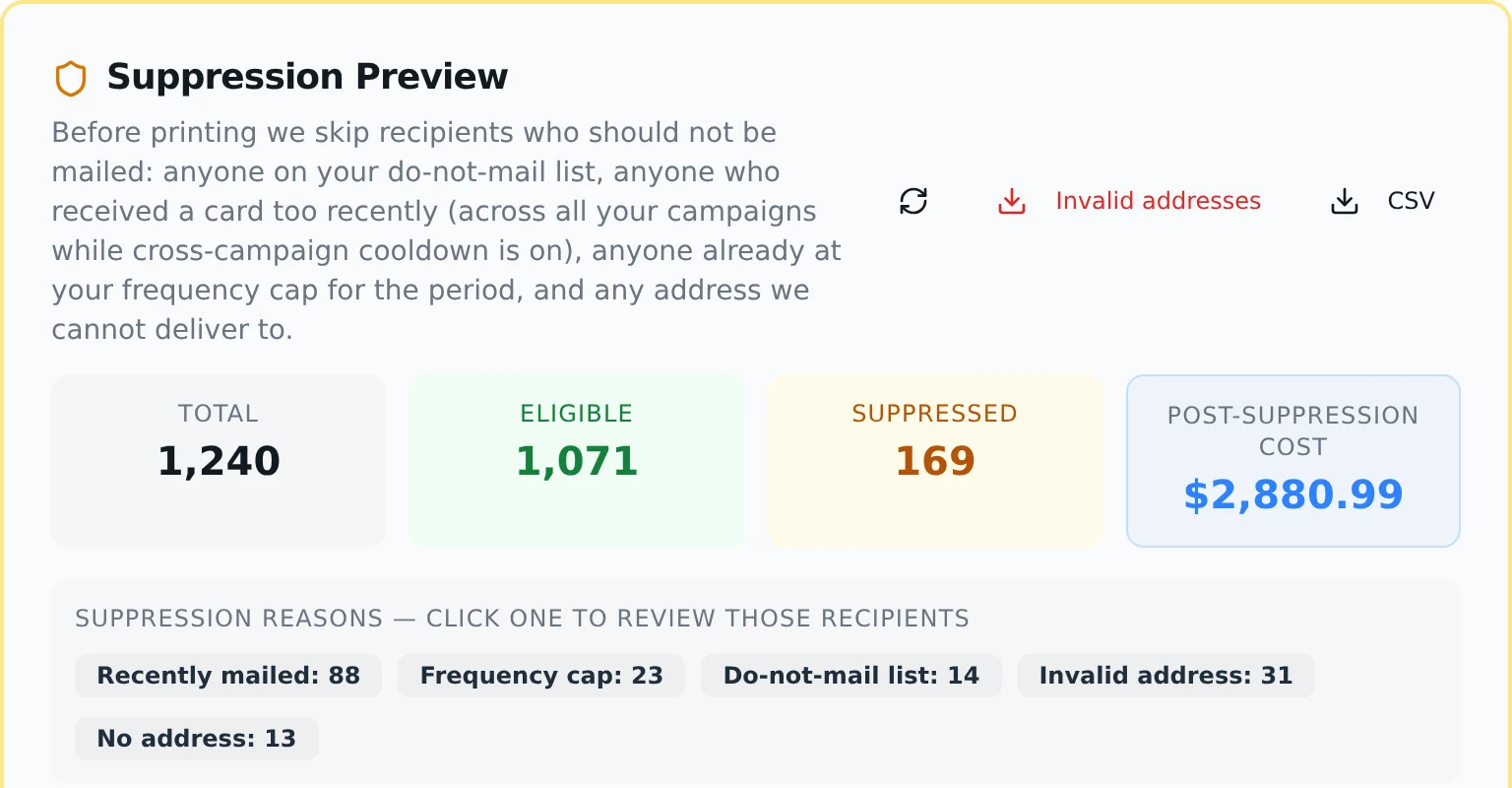
For the setup, see TouchDrop's guides to connecting Klaviyo to direct mail and building Klaviyo postcard flows.
What does this look like in a real account?
When one of our clients, a direct-to-consumer skincare brand, came to us, it had no automations. So we built 11 email flows and 5 SMS flows from scratch.
The timings below are the ones we use as standard across our accounts.
Here's the sequence we built for shoppers who abandon checkout:
- A short checkout reminder email, showing what they left behind and one button back to the cart.
- An SMS reminder for shoppers who opted into texts.
- A follow-up email addressing the most common objection for that product.
For customers who stop ordering, the win-back flow starts around 45 days after their last order. They'll get a recommendation related to their previous purchases. One-time buyers receive an incentive for their second order. If they still don't engage, they move into the sunset flow.
First, they'll get a short plain-text email with a reason to come back. If there's no response after the second attempt, around 48 hours later, we stop emailing them.
This brand doesn't use direct mail yet, so the postcard step here is what we'd add next, not something we've tested. It would sit between the end of the win-back flow and the start of the sunset flow.
We'd send one card to repeat customers who didn't respond to any of the win-back emails or SMS, before they reach the sunset emails and we stop emailing them.
When is a postcard worth its cost?
An email costs a fraction of a cent, while a postcard costs a few dollars. On TouchDrop, a card costs A$2.99 including print, postage and GST on sends under 501 cards, less on larger sends, and from A$1.89 on Scale sends of 4,000+. Plans start at A$79 a month.
A simple test to decide whether a postcard is worth it is break-even. Divide the cost of one card by the margin on an average order to find the share of recipients who need to place an extra order for the card to pay for itself.
If a card costs about one twentieth of your average order margin, one in 20 recipients need to buy to break even. If it costs a fifth, you need one in five.
That is why customer value matters, as a lapsed repeat customer with a high average order value usually makes it worth it. A one-time buyer of a cheap product likely won't.
Instead of mailing everyone who stops engaging, use lifetime value and margin to set the thresholds in your segments.
How do you measure whether it worked?
To measure if your postcards worked, give every card a unique discount code and QR code. Then, match orders back to the customer, and judge the results only after the attribution window closes.
Mail often stays in a pile until people decide to read it, so orders keep coming in for weeks. TouchDrop's guide to measuring direct mail ROI suggests a 60-day default window.
Deliberately don't mail a random portion of each eligible segment. The difference in revenue per customer between the group that receives postcards and this holdout group can be attributed to the card.
TouchDrop's PhycoHealth case study is a good example of reading results honestly. A reactivation campaign to repeat customers who had stopped ordering and stopped opening email returned $4.78 in attributed revenue for every $1 spent (a 4.78x attributed ROAS). That send didn't hold back a control group, so TouchDrop presents the figure as revenue credited to the cards, not proof of how much extra revenue the cards caused.
Does mail always beat email or SMS?
No, for most customers, email and SMS are effective at a fraction of the cost. Mail is slower, more expensive, and can't be altered once sent, so it's the wrong tool for time-sensitive things, low-value customers, or broad promotions.
It does have an advantage in reaching the high-value customers that digital channels can't anymore. Treat mail as a targeted step in your flows, not as a high-volume channel.
Where to start
Win-back is usually the easiest flow to start with because the customers already know your brand. Build the segment in Klaviyo and add a postcard as the final step for repeat customers who didn't respond to email and SMS. Then, hold back a random group, and calculate the results after the attribution window closes.
If the card pays for itself against the holdout group, extend it to your VIP and sunset flows. For a starting point for the flows, we use these email flow examples in all of our accounts.
Once you're ready to set it up, TouchDrop connects straight to your Klaviyo segments.
About the author
Gavin Hewitson is the founder of In-box, a Klaviyo Master Gold Partner and certified Omnisend Partner email and SMS agency. Over five years, he and his team have worked with more than 500 ecommerce brands. Read more of their guides at in-box.com/insights.
Add a postcard step to your Klaviyo flows.
Connect Klaviyo, point a campaign at your win-back segment and see who would be mailed before anything prints.
Get started free