
PhycoHealth Reactivated Lapsed Customers Email Couldn't Reach
PhycoHealth, an Australian health and wellness brand, had a growing list of repeat customers who had gone quiet on email. Their first TouchDrop campaign mailed that exact segment a postcard, and it attributed a 4.78x ROAS, with orders still coming in weeks after the send.
Last updated: 4 September 2026
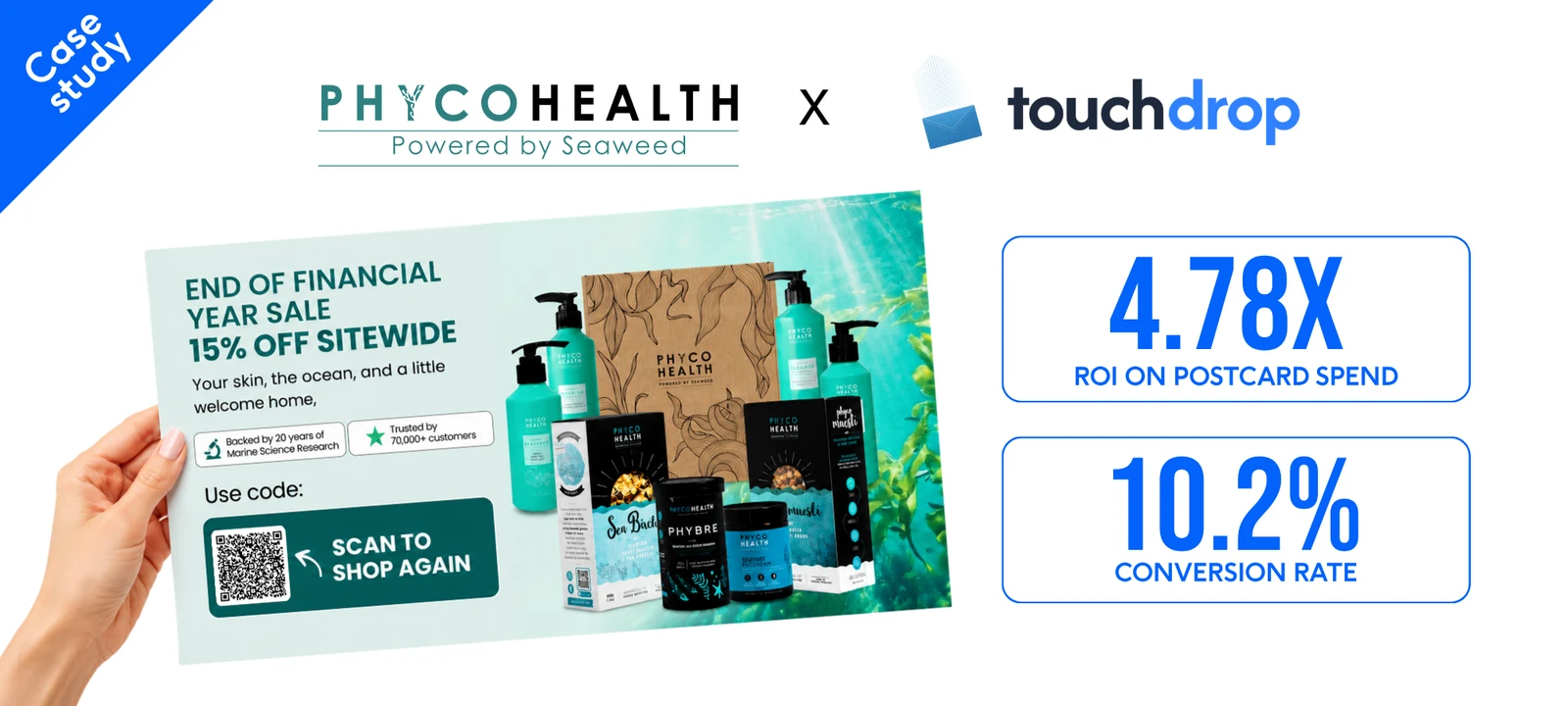
Case-study graphic based on the mailed creative; the QR code shown is a mockup, not a live personalised link.
Short answer: PhycoHealth built a Klaviyo segment of customers who had ordered more than once, hadn't bought in 90+ days, and had stopped opening emails, and mailed them a single postcard with a reactivation offer. Each mailed card carried a unique discount code and QR code, and TouchDrop's recipient-level attribution — a mix of unique codes, QR activity, and customer or address matching — measured a 4.78x ROAS ($4.78 in attributed revenue per $1 of postcard spend).
The problem: paying customers email had lost
PhycoHealth's repeat buyers were exactly the customers worth winning back: people who had already bought more than once. But a chunk of that list had stopped opening email entirely, which meant every win-back flow built in Klaviyo was running into an empty inbox. The list still existed, the customers still had a delivery address on file from their last order, but the channel reaching them had gone quiet.
The approach
Built the segment in Klaviyo
Repeat customers (2+ orders), 90+ days since their last order, and low or no email engagement — built once in Klaviyo and pulled straight into TouchDrop.
One postcard, one strong offer
A single DL (210×99 mm) postcard with a reactivation discount, personalised with the recipient's name, a unique discount code and a QR code.
Printed and lodged in Australia
Cards were printed and lodged inside Australia via Australia Post, so a campaign built one week was landing in letterboxes the next.
Tracked per recipient
The discount code and QR code are unique to each customer, so any order that follows attributes back to that individual and the campaign, not just to a general uplift.
The result
The campaign attributed a 4.78x ROAS — $4.78 in tracked revenue for every $1 spent on postcards — measured through TouchDrop's recipient-level attribution across unique codes, QR activity, and customer or address matching, not code or QR scans alone. It kept climbing for weeks after the send, since a discount code stays live until it's redeemed or it expires rather than stopping on a fixed date. This is the same play our reach-unengaged-customers guide describes: mail the people your inbox no longer reaches, using an address you already hold.
Frequently asked questions
Who is PhycoHealth?
PhycoHealth is an Australian health and wellness brand selling seaweed-based nutrition products direct to consumers online.
What audience did they mail?
Customers who had ordered more than once, hadn't ordered in 90 or more days, and had stopped opening PhycoHealth's emails — a segment built in Klaviyo and pulled straight into TouchDrop, the exact play our reach-unengaged-customers guide describes.
What was on the card?
A single postcard carrying a reactivation offer, a unique discount code tied to the recipient's Shopify record, and a personal QR code, printed and lodged inside Australia via Australia Post.
How is the result tracked?
TouchDrop attributes orders back to a campaign at the recipient level: a unique discount code, QR activity, and matching by customer or delivery address — most of this result came through customer and address matching, not code or QR scans alone. This send did not run a holdout, so treat the 4.78x as an attributed ROAS (return on ad spend) rather than a holdout-proven incremental lift — for campaigns where isolating incrementality matters, hold out a random slice as described in our reach-unengaged-customers guide.
How long did it take to see results?
The campaign sent in mid-June 2026. Orders kept attributing for weeks afterwards, because a discount code stays redeemable until it's used or expires rather than closing on a fixed date.
Can I get a similar result?
Treat this as one real result, not a guarantee — plan around 2.5x incremental return as an honest midpoint for well-targeted retention mail, and always run a holdout so your own number is real.
Related reading
Reactivate the customers your email can't reach.
Build the segment, set one strong offer, and mail a card that lands where the inbox doesn't.
Get started free