
vybey’s Win-Back Postcards: Three Sends, Measured
vybey is the brain-health nutrition brand TouchDrop’s co-founders also run. In 2026 it mailed lapsed customers three times through TouchDrop, twice in Australia and once in the UK. Below are the card, who received it, and the timing from TouchDrop’s records.
Last updated: 18 October 2026
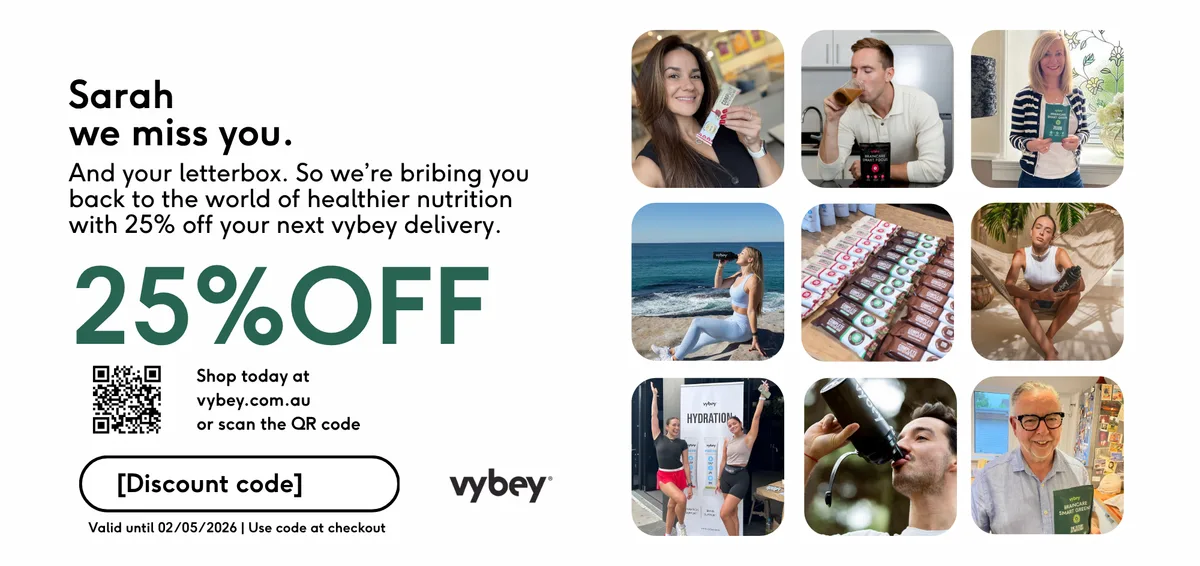
vybey’s April 2026 card design, shown with a sample name and a placeholder code box. Each printed card carried the customer’s own name, discount code and tracked QR code.
Short answer: vybey, the founders’ own brand, mailed three win-back postcard sends through TouchDrop in 2026: 1,901 cards across Australia and the UK. The first QR scans came 3 to 5 days after lodgement. 23 orders used the card’s discount code, a median of 15 days after lodgement, and the last on day 39.
Our own brand, reported in full
TouchDrop’s co-founders, Hylke Reitsma and Gordon Belch, also co-founded vybey. Because vybey is ours, we can show the whole picture: the card, the audience, the dates and the timing. Read it as the founders’ own result. For an independent customer, see the PhycoHealth case study.
The card
The April 2026 card opened with the customer’s first name and “we miss you”, and offered 25% off their next vybey delivery. Each card carried a discount code and a QR code that belonged to that one customer, so any order that used them traced back to the card. TouchDrop printed and lodged the Australian cards inside Australia via Australia Post, and printed the UK cards in the UK for posting with Royal Mail.
Who got each send
| Send | Market | Audience | Lodged |
|---|---|---|---|
| April 2026 | Australia | Customers who had cancelled their vybey subscription | 14 April 2026 |
| End of financial year | Australia | Customers with more than one order, at least one in the past year and none in the last 60 days | 19 June 2026 |
| July 2026 | UK | Customers who had ordered in the past two years but not in the last 60 days, plus email subscribers who had not bought in that time | 28 July 2026 |
When orders came in
The first QR scans came 3 to 5 days after lodgement on each send. Coded orders took longer. Of the 23 orders that used the card’s discount code:
- 3 arrived within 7 days of lodgement
- 10 within 14 days
- 16 within 21 days
- 21 within 30 days
- the last on day 39
Fewer than half had arrived by day 14. If vybey had judged these sends after two weeks, it would have missed most of the coded orders. TouchDrop’s 60-day attribution window covers the whole spread.
What we took from it
Wait a month before you judge
Fewer than half the coded orders had arrived by day 14, and the last came on day 39.
Give every card its own code
A code and a QR code per recipient tie each order back to one card, whether the customer scans or types.
Lodgement runs weekly
Automated cards go out in one weekly print run, so a trigger late in the week waits for the next one.
Frequently asked questions
Is vybey a TouchDrop customer?
vybey is the founders' own brand. Hylke Reitsma and Gordon Belch co-founded both vybey and TouchDrop, so read these figures as our own results. For an independent customer, see the PhycoHealth case study.
What did the card offer?
The April 2026 card greeted each customer by first name and offered 25% off their next vybey delivery. Every card carried a discount code and a QR code that belonged to that one customer.
Who received the cards?
In Australia, customers who had cancelled their vybey subscription (April), then customers with more than one order who had not ordered in 60 days (June). In the UK, customers who had not ordered in 60 days plus email subscribers who had not bought in that time (July).
How long did orders take to arrive?
The first QR scans came 3 to 5 days after lodgement. The 23 orders that used the card's discount code arrived a median of 15 days after lodgement: 10 by day 14, 21 by day 30, and the last on day 39.
Does this show what my campaign will return?
These figures cover timing and tracking for one brand across three sends. They leave out revenue, and your offer, audience and product will differ. For a number you can trust, mail a test and hold back a random group as a control.
Related reading
Win back the customers who stopped ordering.
Build the segment, set one offer, and give every card its own code.
Get started free